
6 Best AI Study Tools
We have all spent hours trying to get a general chatbot to understand a complex textbook chapter, only to receive a generic summary that misses the point. If you are tired of vague answers and constant fact-checking, you are likely looking for ai study tools that are better than chatgpt for specific academic tasks.
Relying on a single prompt box for every assignment often leads to more work, not less. You need platforms built for source-heavy research, essay drafting, and long-term memory. We tested the latest options to find out which ones actually save time without sacrificing accuracy.
This guide breaks down the top choices for organizing your notes, finding verified citations, and mastering active recall. Here are the best specialized assistants to help you manage your workload more effectively.
The tools at a glance
Best for: general help, problem-solving, and Socratic tutoring
Pricing: Free tier + paid plans (Plus, Pro, Team, Edu)
Read more →How We Evaluated
- Our team uploads specific lecture notes and PDFs to ensure the tool restricts its responses to provided materials rather than general training data.
- Our team manually verifies every generated citation against the original source to identify when the AI misattributes or fabricates references.
- Our team tests if the tool enables active learning by providing hints and guiding questions instead of delivering finished answers.
- Our team triggers the creation of flashcards and quizzes to evaluate how accurately the AI captures essential concepts from dense academic sources.
Best pick by use case
Best overall
NotebookLM
It answers questions only from uploaded documents and cites them, reducing hallucination risk.
Best free option
ChatGPT
It offers a free version with a wide range of features, including its new Study Mode.
Best for research with citations
Perplexity
It searches the live web for each query and attaches numbered, clickable citations.
Best for active recall and flashcards
Quizlet
It specializes in active recall and flashcards, making it a great tool for students who want to memorize information.
Best for long reading and essay drafting
Claude
It is preferred by students in humanities for long reading and essay drafting tasks.
Best for quick general help
Copilot
It provides quick general help and is a good option for students who need assistance with a wide range of topics.
The tools in depth
1. NotebookLM
Best for: studying source material
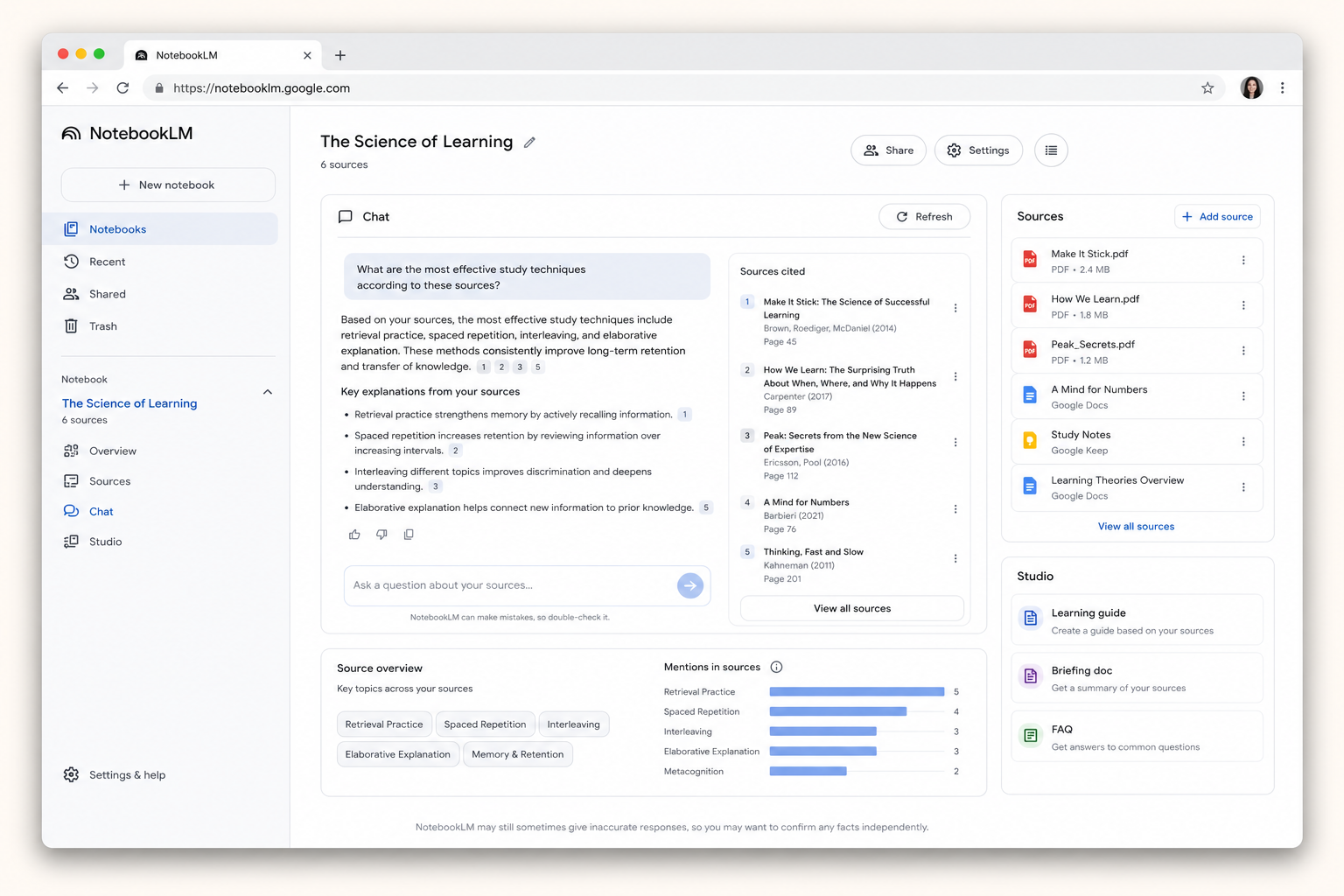
NotebookLM is a source-grounded AI tool that answers questions from uploaded documents and provides citations.
Built on Google's Gemini using retrieval-augmented generation, NotebookLM restricts its answers to specific documents uploaded by the user, such as PDFs, notes, and YouTube videos. It automates the creation of study materials, including flashcards, quizzes, and audio/video overviews, while ensuring all claims are tied to verifiable inline citations.
Pros
- Source-grounded to minimize hallucination risk
- Provides inline citations directly to user materials
- Generates interactive study aids like quizzes and audio overviews
Cons
- Can still oversimplify complex topics or occasionally fabricate details
- Daily limits on chat queries and audio overview generations
- Less optimized for step-by-step problem solving than specialized tutor modes
2. Perplexity
Best for: web research with citations
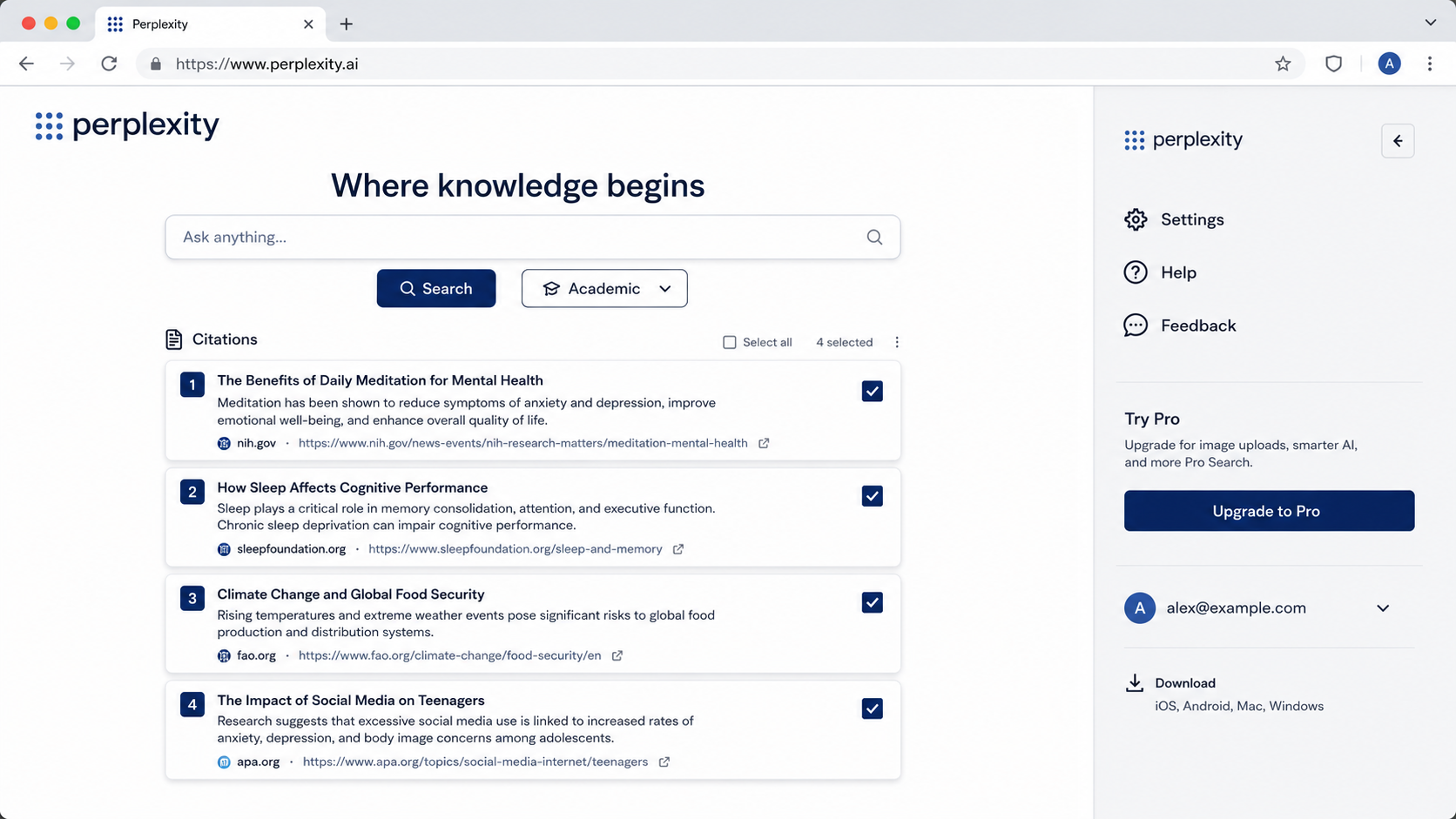
Perplexity is an AI tool that searches the live web for each query and provides numbered, clickable citations.
Perplexity acts as a research accelerator by conducting real-time web searches and anchoring its responses to specific sources. It includes an 'Academic' focus mode designed for literature reviews and research, though it is intended to be used as a starting point rather than a final authority. While it outperforms general chatbots in citation frequency, independent testing shows its accuracy remains imperfect and requires manual verification.
Pros
- Performs live web searches for each query
- Attaches numbered, clickable citations to responses
- Higher source-grounding rate (78%) for complex questions than ChatGPT
Cons
- Citations found to be incorrect 37% of the time
- Premium tiers can be more 'confidently incorrect' than free versions
- Unreliable for blind use without manual verification
3. ChatGPT
Best for: general help, problem-solving, and Socratic tutoring
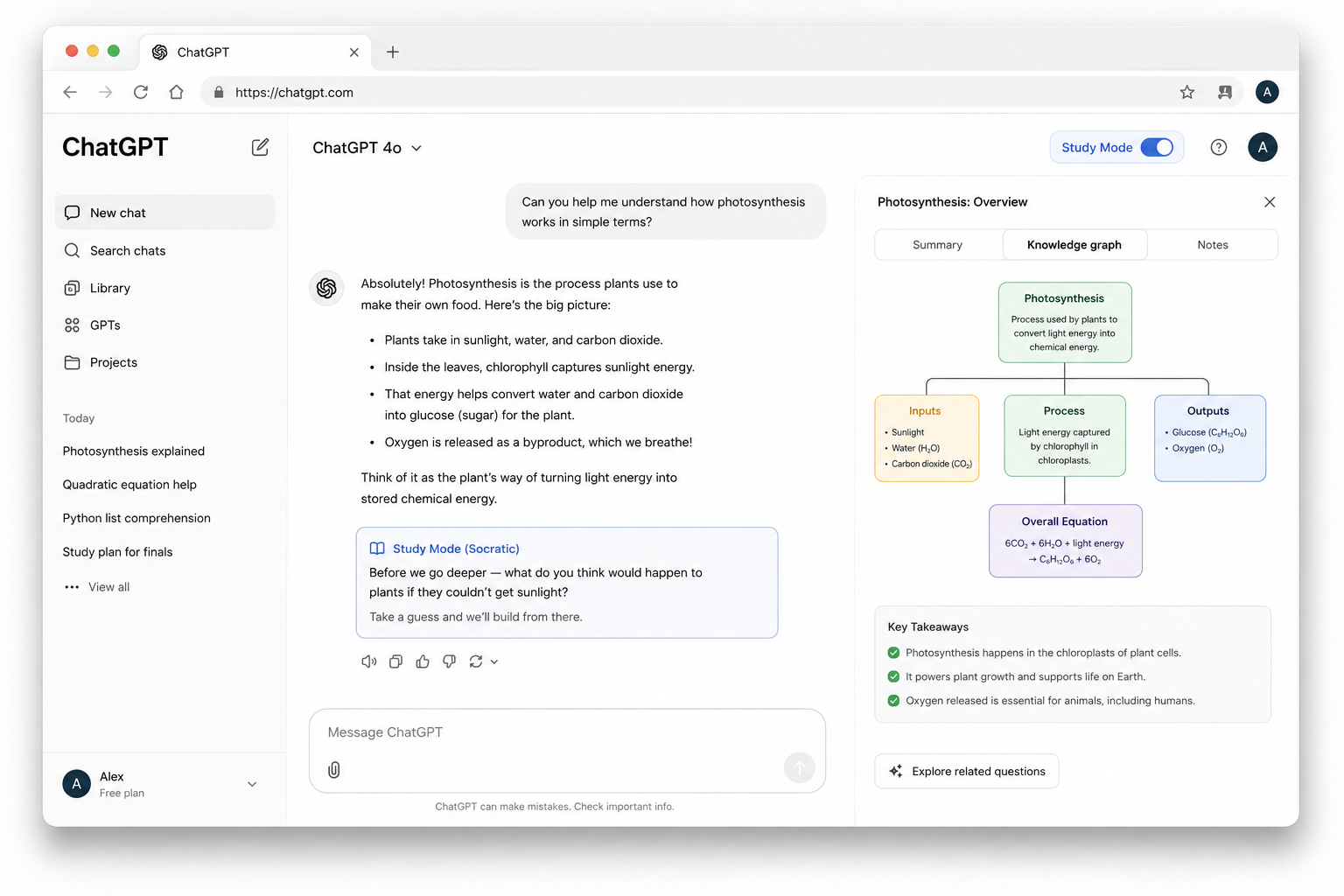
ChatGPT is a general-purpose AI chatbot that provides answers and assistance, including a Study Mode for students.
Developed by OpenAI, ChatGPT is a versatile AI assistant that performs a wide range of tasks including writing, coding, and general reasoning. It includes a specialized 'Study Mode' launched in 2025 that uses Socratic questioning to help students learn concepts through hints rather than providing direct answers. While highly flexible, it draws from general training data and lacks the strict source-grounding found in specialized research tools.
Pros
- Features a Socratic Study Mode for active learning
- Broad reasoning capabilities for complex problem-solving
- Available across multiple tiers including Free, Plus, and Edu
Cons
- Lower citation accuracy (62%) compared to specialized research tools
- Potential for 'cognitive debt' if over-relied upon for essay generation
- Prone to hallucinating sources when not used with specific grounding techniques
4. Claude
Best for: long reading and essay drafting
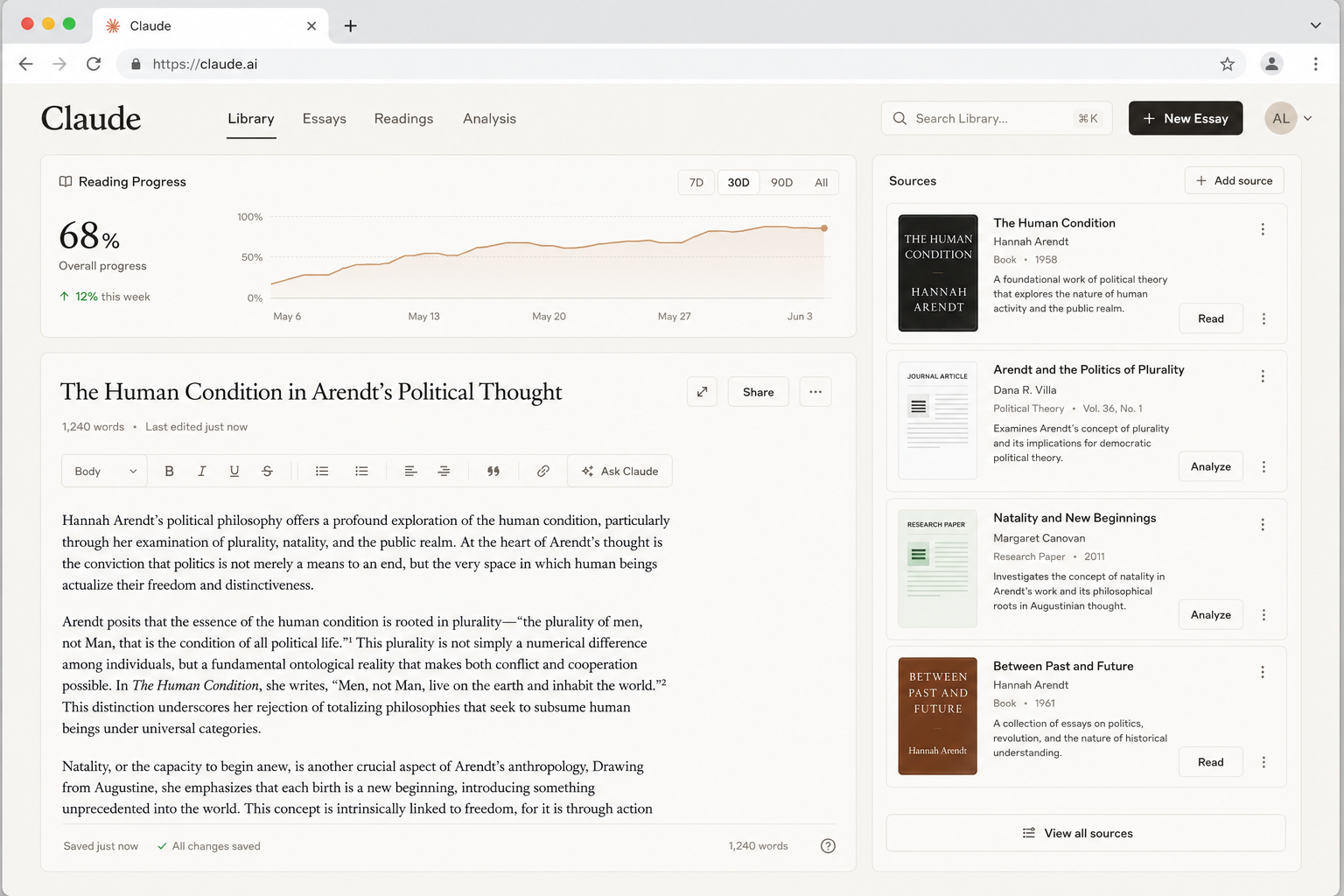
Claude is an AI tool that assists with reading and writing tasks, particularly in the humanities.
Claude is an artificial intelligence assistant frequently used for academic tasks requiring the synthesis of extensive source materials. It is particularly popular among humanities students for its ability to help understand long texts and assist in the drafting of structured essays.
Pros
- Excellent for processing and understanding long reading materials
- Preferred for essay drafting and long-form writing tasks
- Strong performance in humanities-focused academic work
Cons
- Requires manual verification to ensure accuracy
- Subject to hallucinations typical of large language models
- Lacks the specialized source-grounding features of tools like NotebookLM
5. Quizlet
Best for: active recall and flashcards
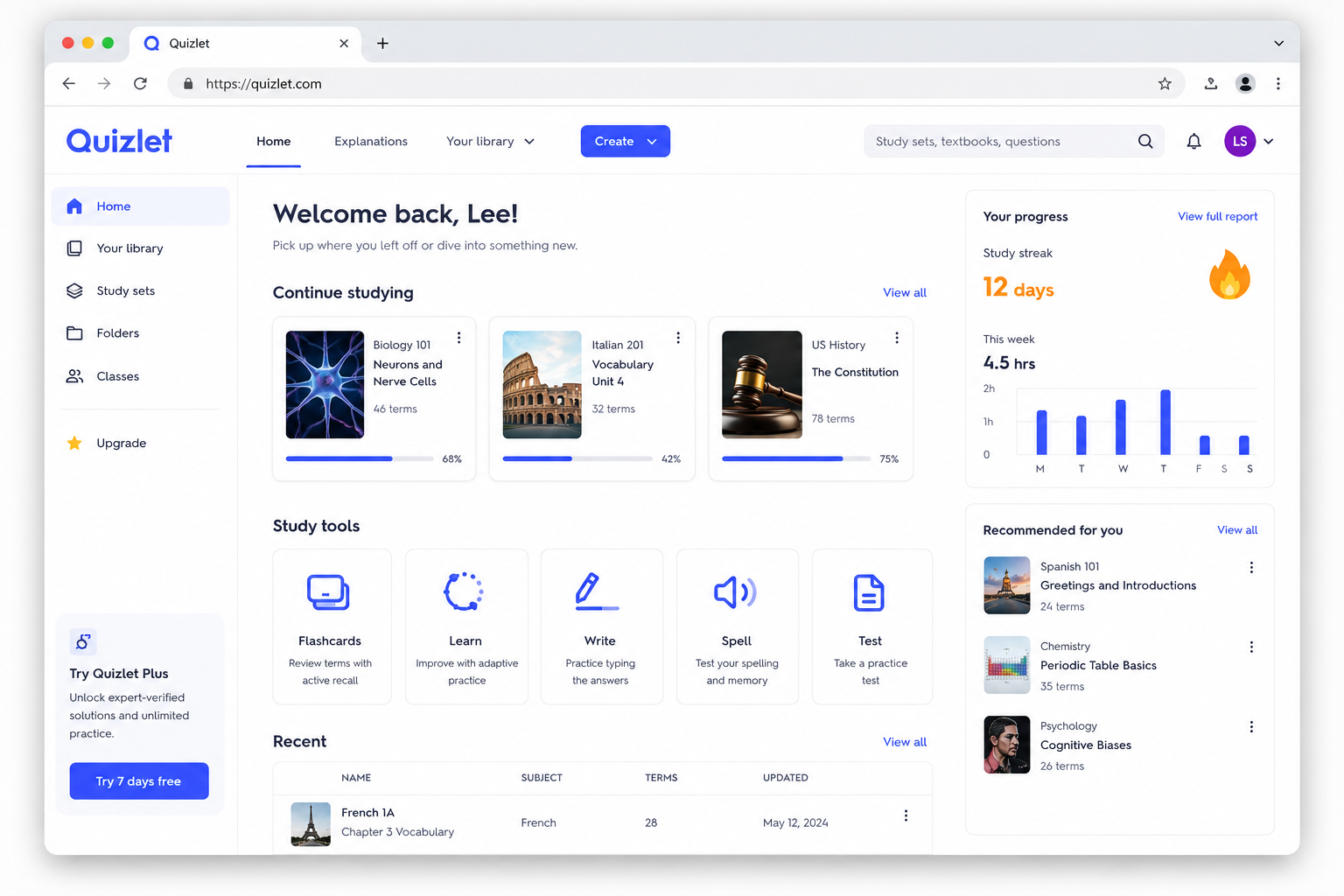
Quizlet is a study app that uses flashcards and other interactive tools to help students learn and retain information.
Quizlet provides a platform for students to create and study digital flashcards across a wide range of academic subjects. It employs active recall and spaced repetition techniques through various study modes, including practice tests and gamified learning, to improve student retention and mastery of material.
Pros
- Access to millions of pre-made user-generated study sets
- Multiple interactive study modes such as Match and Test
- Highly effective for vocabulary and fact-based memorization
Cons
- Accuracy depends on user-generated content quality
- Advanced features and offline access require a paid subscription
- Less suited for deep conceptual analysis compared to source-grounded AI tools
6. Copilot
Best for: quick general help
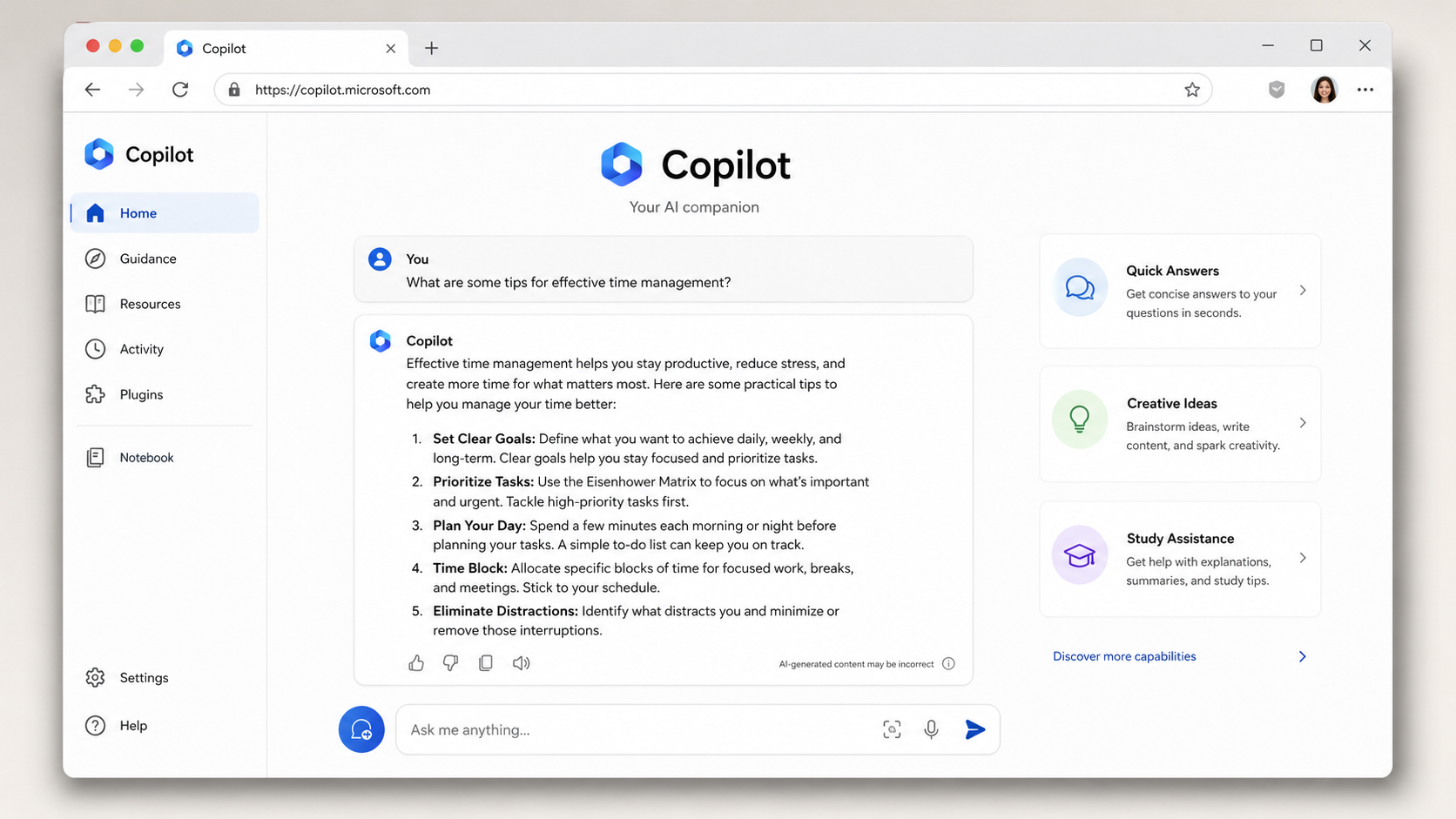
Copilot is an AI tool that provides general assistance and guidance, often used in conjunction with other tools.
Copilot is a general-purpose AI assistant designed for broad information retrieval and creative reasoning. While effective for quick support and general queries, it functions as a general chatbot rather than a source-grounded study tool, meaning it lacks specialized features like document-restricted answering or automated flashcard generation. It is best utilized for broad assistance where deep academic grounding is less critical.
Pros
- Excellent for quick general assistance
- Broad creative and general reasoning capabilities
- Useful for wide-ranging information retrieval
Cons
- Lacks the specific source-grounding of specialized study tools
- Higher risk of hallucination compared to document-restricted AI
- Likely to produce citation errors during web research
The verdict
NotebookLM is the best overall choice because it grounds answers in your specific documents, which limits hallucinations. For web research, Perplexity earns the top spot by providing clickable citations, though its accuracy still requires manual verification. Claude is the best option for long-form reading and drafting humanities essays. While ChatGPT's Study Mode helps with step-by-step problem solving, these specialized tools provide the structure and evidence-based grounding that general chatbots lack. Use NotebookLM to master your own materials and Perplexity to explore the live web.
Frequently asked questions
Are there AI study tools that are better than ChatGPT?
Specialized tools often outperform general ChatGPT for specific academic tasks. NotebookLM provides higher accuracy for personal notes by restricting answers to your uploaded documents, while Perplexity offers superior web research with live citations. ChatGPT remains a strong general tool, but its effectiveness depends on whether you need source-grounding or broad reasoning.
Which AI tool is best for researching with citations?
Perplexity is the preferred choice for research because it searches the live web and attaches numbered, clickable links to every response. Research shows it ties claims to specific sources 78% of the time, compared to 62% for ChatGPT. Despite this advantage, you must still verify every citation because the tool still makes mistakes in over one-third of its tests.
How does Google NotebookLM compare to ChatGPT for studying?
NotebookLM differs from ChatGPT by using your own uploaded documents, such as PDFs and lecture slides, to generate answers. This source-grounded approach significantly reduces the risk of fabricated information and allows the tool to create specific flashcards and quizzes from your class material. While ChatGPT is better for open-ended brainstorming, NotebookLM excels at deep analysis of provided texts.
What is ChatGPT's Study Mode and how does it help?
OpenAI launched Study Mode to help students learn through Socratic questioning rather than receiving instant answers. This feature provides hints and guides users through complex logic to encourage active thinking and long-term retention. It addresses concerns about AI leading to weaker brain connectivity by forcing students to participate in the problem-solving process.
Can students trust AI study tools to provide accurate citations?
Current research indicates that no AI tool is fully reliable for identifying sources, as even the best performers fail over 30% of the time. High-tier paid versions often produce incorrect answers with more confidence than free versions. Use these tools to find a starting point for your research, but always check the original source material yourself.